How to Rank for a Keyword in SEO: Step-by-Step Guide
On this page
Key Points
- Start with one keyword you can realistically win based on intent, authority and business value.
- Score winnability before writing by checking link gaps, SERP features, freshness pressure and page-type fit.
- Read the SERP first, then match one keyword cluster to one clear page type.
- Optimize for humans with strong titles, useful structure, original proof and natural semantic coverage.
- Track clicks, conversions and AI citations because rankings alone miss how search visibility works now.
Ranking higher on Google can make a big difference in organic traffic. According to Backlinko's analysis of 4 million search results, the No. 1 organic result receives an average click-through rate (CTR) of 27.6%.
But rankings are no longer just about traditional search results. Semrush's 2025 study found that AI Overviews appeared for roughly 13% of tracked keywords by March 2025, changing how users discover information.
SEO also takes time. First Page Sage's 2026 benchmarks suggest that many campaigns take 6 to 12 months to achieve positive ROI.
With Google's AI Overviews and AI Mode, businesses now need to focus on more than keyword positions. Visibility in AI-generated answers and source citations also matters.
The goal isn't just to rank higher. It's to earn clicks, attract relevant visitors and build visibility across both traditional and AI search. Learn more about this shift in our guide to the rise of GEO.
Start with a keyword you can actually win, not the one with the biggest volume
Choosing the right keyword isn't just about search volume. A keyword might attract thousands of searches, but if those visitors aren't interested in your product or service, it won't help your business grow.
Start by creating a shortlist of 10 to 20 potential keywords using Google Search Console, customer conversations, competitor pages and keyword research tools.
For example, imagine you run an AI search visibility platform that helps businesses track their brand presence across ChatGPT, Gemini and Google AI Overviews. Your initial keyword list might include:
AI search visibility
AI visibility tracking tools
Best GEO tools
How to rank in ChatGPT
AI brand monitoring software
Generative engine optimization tools
Not every keyword deserves its own page. Before choosing one, evaluate it using four questions.
Is the keyword relevant to your business?
Choose keywords directly related to the products or services you offer.
Example:
"AI visibility tracking tools" is highly relevant because your platform helps businesses monitor their visibility across AI search engines.
"How to use ChatGPT for writing emails" is less relevant because users want help with writing, not AI search visibility.
What to check: Ask whether someone searching this keyword could realistically become your customer.
2. Does the search intent match your content?
Search intent explains what users want to accomplish when they search.
There are four main types of keyword intent:
Keyword Type | Example | Best Content Type |
Informational | What is generative engine optimization? | Educational blog |
Navigational | EasilyGeo login | Login page |
Commercial | Best AI visibility tracking tools | Comparison article |
Transactional | AI visibility tracking software pricing | Product or pricing page |
What to check: Search your target keyword on Google and examine the top-ranking results. If most results are comparison articles, creating a general product page may not match what users expect.
3. Can your website realistically rank?
Some keywords are dominated by established websites with strong backlink profiles and years of authority.
Example:
"SEO tools" is a broad, highly competitive keyword.
"AI search visibility tracking tools for small businesses" is more specific and may offer a more achievable ranking opportunity.
What to check: Compare the ranking websites' authority, referring domains, content quality and topical relevance with your own website. Keyword difficulty scores can help, but they shouldn't be your only deciding factor.
4. Will this keyword bring valuable visitors?
Traffic alone doesn't guarantee conversions. Prioritise keywords that attract people likely to need your services.
Example:
"What is GEO in SEO?" may attract people who are just learning about generative engine optimization.
"Best AI brand monitoring tools" may attract marketers actively comparing platforms for their business.
Both keywords can be useful, but the second has a clearer connection to a potential purchase.
What to check: Consider whether the keyword could generate enquiries, demo requests, sign-ups or sales.
How Many Keywords Should You Target on One Page?
Once you've selected your primary keyword, choose 3 to 8 closely related variations as a practical starting point, not a strict SEO rule.
For example:
Primary keyword: AI visibility tracking tools
Related keyword variations:
AI search visibility tracking tools
AI visibility monitoring tools
AI search monitoring software
AI brand visibility tracking
AI visibility tracking software
These keywords share a similar purpose, so they can often be covered naturally on one product or service page.
However, "Best AI visibility tracking tools" may have a different intent. Users searching this phrase typically want to compare multiple platforms, so it may deserve a separate comparison article.
The key takeaway: Don't create separate pages for every keyword variation. Group keywords by search intent and create a dedicated page only when users need a meaningfully different answer.
For more examples of keyword targeting and search visibility, explore our AI search visibility blog.
How to Evaluate Keyword Ranking Difficulty
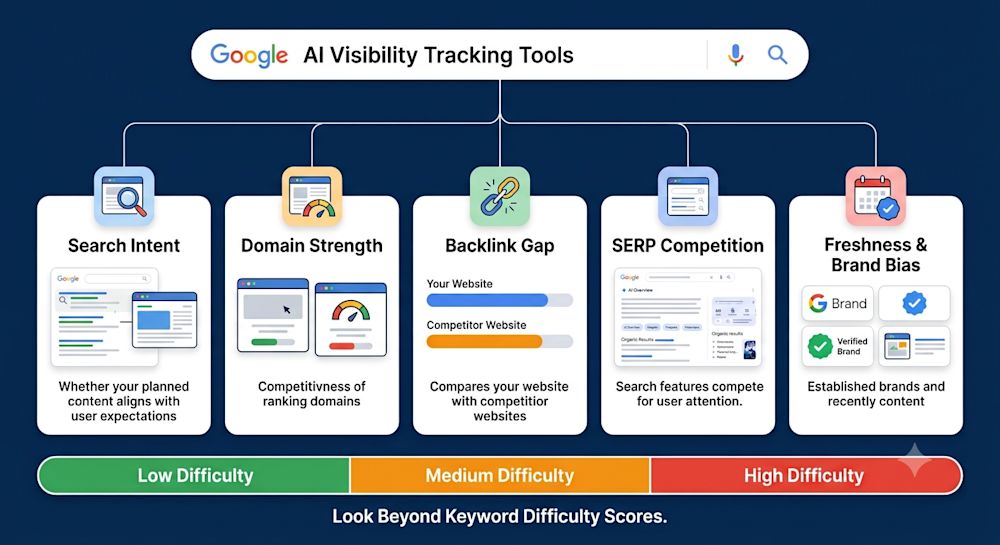
Before targeting a keyword, it's important to understand how difficult it will be for your website to rank. Instead of relying only on keyword difficulty scores from SEO tools, analyse these five factors to identify realistic ranking opportunities.
Intent Match: Does Your Content Match Search Intent? Search intent is the reason behind a user's search. Some users want information, while others want to compare products, find a service, or use a tool.
How to check search intent:
Search your target keyword on Google.
Analyse the top 10 organic results.
Identify whether the ranking pages are blogs, service pages, product pages, or tools.
Look for the most common page type.
Check whether your planned content matches what users are searching for. For example, if you search for "bulk keyword rank checker" and most results are tools, creating a tool page would be more relevant than writing an informational blog. How to evaluate difficulty:
High Difficulty: Your planned page type doesn't match the dominant search results.
Moderate Difficulty: Your content partially matches search intent.
Low Difficulty: Your page type matches the dominant results and addresses the same user need.
2. Domain Strength: Can Your Website Compete? Domain strength helps you understand how competitive your website is compared to websites already ranking for your target keyword. You can use SEO tools to compare Domain Rating (DR) or Domain Authority (DA). These are third-party metrics, not official Google ranking factors. How to check domain strength:
Search your target keyword and identify the top-ranking websites.
Check their DR or DA using an SEO tool.
Compare those metrics with your website.
Look for smaller websites ranking alongside established brands.
Check whether those websites have strong topical relevance. For example, if your website has a DR of 25 and most ranking websites have a DR above 80, competing may be challenging. However, if several websites with a DR between 20 and 35 are ranking, you may have a better opportunity. How to evaluate difficulty:
High Difficulty: Most ranking websites are significantly stronger than yours.
Moderate Difficulty: The results contain a mix of stronger and similarly established websites.
Low Difficulty: Your website has comparable domain strength to the ranking websites.
3. Link Gap: How Strong Are Your Competitors' Backlinks? A link gap is the difference between the backlink profiles of your page and competing pages. When evaluating backlinks, focus on referring domains, which are unique websites linking to a page. For example, 20 backlinks from one website count as one referring domain, while 20 backlinks from 20 different websites count as 20 referring domains. How to check the link gap:
Collect the top three ranking URLs for your target keyword.
Enter those URLs into a backlink analysis tool.
Check the number of referring domains linking to each page.
Compare their backlink profiles with your existing page.
Analyse the quality and relevance of those links. For example, if the top-ranking pages have 100 referring domains and your page has only 15, there is a significant link gap. However, this doesn't mean you need exactly 100 referring domains to rank. Relevant backlinks, content quality, and search intent also influence rankings. How to evaluate difficulty:
High Difficulty: The top-ranking pages have significantly stronger backlink profiles.
Moderate Difficulty: The backlink gap is manageable.
Low Difficulty: Your page has a similar or stronger relevant backlink profile.
4. Feature Crowding: How Much Space Do Organic Results Get? Feature crowding happens when Google's search results contain multiple elements that compete for attention. These include AI Overviews, featured snippets, sponsored listings, videos, shopping results, and local packs. Even if your page ranks in the top five, these features may reduce the number of clicks your website receives. How to check feature crowding:
Search your target keyword on Google.
Check whether an AI Overview appears.
Look for sponsored results, videos, shopping listings, and featured snippets.
See how far users need to scroll before reaching organic results.
Compare the search results on desktop and mobile. For example, a search for "best AI SEO tools" might show sponsored results, an AI Overview, and videos before traditional organic listings. This means ranking in position three may generate fewer clicks than ranking in the same position for a keyword with fewer SERP features. How to evaluate difficulty:
High Difficulty: AI Overviews, videos, shopping results, or other features dominate the SERP.
Moderate Difficulty: Some SERP features appear, but organic results remain visible.
Low Difficulty: The SERP primarily contains standard organic results.
5. Freshness or Brand Bias: What Type of Websites Does Google Prefer? Some keywords favour recently updated content, while others are dominated by established brands. Freshness bias occurs when users expect current information. Brand bias describes search results where established brands consistently dominate. How to check freshness and brand bias:
Search your target keyword and open the top-ranking pages.
Check their publication and last-updated dates.
Identify whether recently updated articles dominate the results.
Look at how many established brands appear in the top 10.
Check whether smaller or niche websites are also ranking. For example, the keyword "best AI visibility tools 2026" may favour recently updated comparison articles because tools, pricing, and features change frequently. If the top results are dominated by established brands publishing regularly updated content, a newer website may face stronger competition. How to evaluate difficulty:
High Difficulty: Established brands or frequently updated pages dominate the results.
Moderate Difficulty: There is some brand dominance or freshness pressure.
Low Difficulty: Smaller websites can compete, and the topic doesn't require frequent updates. How to Decide Which Keywords to Target After reviewing all five factors, classify your keyword opportunity:
Low Difficulty: Your content matches search intent, your website can compete with ranking pages, and organic results have good visibility. Prioritise these keywords.
Moderate Difficulty: Some competitors have stronger authority or backlinks, but there are still opportunities. Target these keywords with high-quality content and a clear SEO strategy.
High Difficulty: Strong competitors dominate, the backlink gap is significant, or your planned content doesn't match search intent. Consider targeting more specific long-tail keywords first.
How Long Does It Take to Rank for a Keyword?
There is no fixed timeline for ranking on Google. It depends on keyword competition, website authority, content quality, search intent, and how well your page satisfies the user's needs.
Based on practical SEO planning, here are some broad timelines:
Low-competition, long-tail keywords: You may start seeing ranking improvements within 6–12 weeks, especially if your website is already established.
Medium-competition keywords: These can take approximately 4–9 months, depending on the competition and content quality.
High-competition keywords: Ranking can take considerably longer and may require strong topical authority, relevant backlinks, and ongoing content improvements.
Read the SERP like a map so you know what Google wants to show before you write
Before creating content for any keyword, the first step is to understand what Google is already ranking for that search query. This helps you identify search intent, the type of content Google prefers, and the patterns followed by top-ranking pages. Instead of assuming what users want, look at the search results to understand what is actually working.
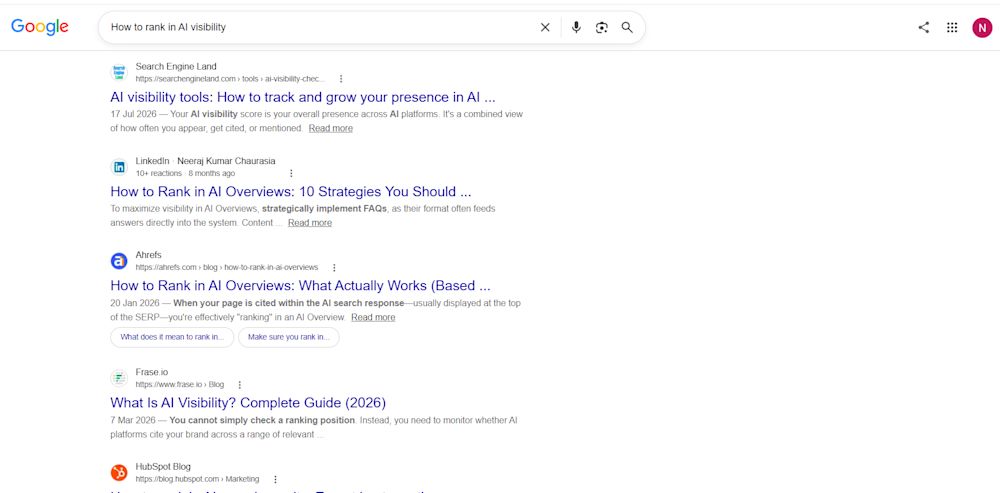
For example, let's say your target keyword is "How to rank in AI visibility." Search for this keyword on Google and carefully analyse the results.
Here's how I usually approach SERP analysis before writing content:
Step 1: Search your target keyword on Google. Enter the exact keyword you want to rank for. Ideally, use a logged-out browser and select the location you're targeting.
Step 2: Identify the SERP features. You might see AI Overviews, YouTube videos, sponsored results, featured snippets, or other search features. Take note of them, but for this exercise, focus on the traditional organic results.
Step 3: Analyse the organic results. Look at the types of pages ranking on the first page. Are they blog posts, service pages, product pages, or landing pages?
Step 4: Find the most common content type. For example, if seven organic results include five blogs and two service pages, that's a strong indication that Google is favouring informational content. In this case, creating a blog post would likely be a better approach than creating a service page.
Step 5: Study the content patterns. Open the top-ranking blogs and analyse their structure. Look at the headings, topics covered, examples, FAQs, content depth, and how they answer the main search query.
Step 6: Create content that matches search intent. Use these patterns to build your content outline, but don't simply copy what others are doing. Cover the essential topics while adding your own experience, practical examples, and useful insights.
Map one keyword to one page type, then build the page around the job it needs to do
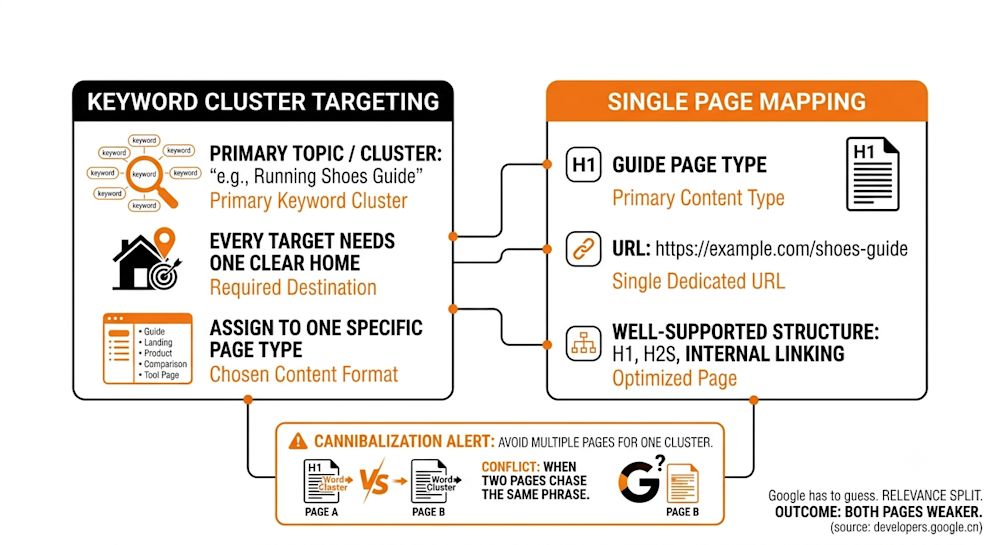
Every target needs one clear home. One primary keyword cluster should map to one URL and one page type: guide, landing page, comparison, tool page or product page. When two pages chase the same phrase, Google has to guess which one deserves the impression. That cannibalization usually leaves both pages weaker than one well-supported URL. ( developers.google.cn)
The easiest way to decide between a new page and an existing URL is to ask which page already has the closest intent match and the strongest internal support. If an older guide already ranks on page two for the topic, updating it is often smarter than launching a fresh page that starts with no authority. Keep the URL slug short, align the H1 with the language people actually use and build H2s around the entities and subtopics the searcher expects to see. ( developers.google.cn)
Once that main page is chosen, build a small cluster around it. Supporting articles can answer narrower questions, cover adjacent comparisons or handle objections, then link back to the main target page with natural anchor text. That structure helps users move through the topic and helps Google understand which page is the primary destination. ( developers.google.cn)
Optimize the page for the keyword without writing like you are feeding a machine
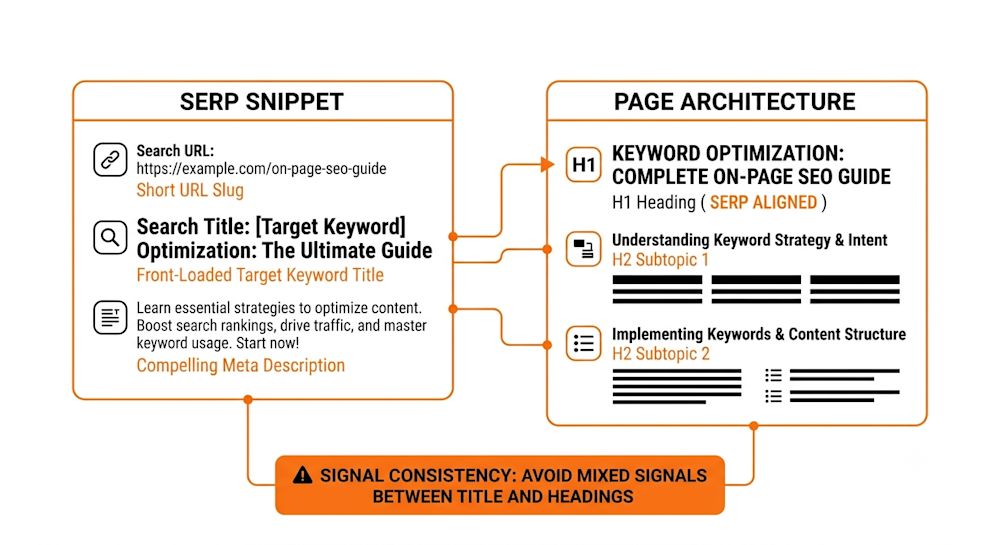
Put the target keyword near the front of the title tag, write a meta description that sells the click, keep the URL short and descriptive, make the H1 align with the phrasing on the results page and use H2s to cover the subtopics searchers clearly expect. Google notes that title links can be generated from the title element and other page headings, so consistency matters more than cleverness. If your title promises one thing and the page headings drift somewhere else, you create mixed signals before the first scroll. ( developers.google.cn)
The body copy should answer the question fast, then go deeper with proof. That means first-hand examples, original screenshots, comparisons, concrete numbers, image alt text where it helps, schema only when it truly fits and internal anchors from relevant pages. Google’s people-first content guidance plus its advice for AI search experiences both point in the same direction: unique content that satisfies the visitor is the foundation for classic rankings, snippets and AI citations. We show that style in our AI-search-ready writing guide. ( developers.google.com)
This is where writers get tempted to repeat the phrase every other line. Do not. Semantic coverage beats repetition. Use the language that naturally comes with the topic, match the dominant format already winning the query and make the first few paragraphs crisp enough to be excerpted. If the results page favors step-by-step guides, write steps. If it favors templates or tools, give people a template or a tool-driven experience. ( developers.google.cn)
Build enough authority around the page that Google has a reason to move you up
Publishing is the midpoint, not the finish line. For any term with real competition, content alone is usually not enough. Start with internal links from relevant high-authority pages, update older pages so they support the new target URL and close obvious link gaps where the leading pages have much stronger referring-domain profiles. Ahrefs’ million-SERP analysis still found links associated with stronger rankings, even as the relationship varies by query type and brand strength. ( ahrefs.com)
External validation works best when it is tightly matched to the page. Original data, a genuinely useful free tool, a sharp comparison or a strong point of view can all earn links without forced outreach. We keep seeing the best results when the asset gives another site a real reason to reference it, which is the same logic behind our GEO tactics that earn citations. ( ahrefscom-3b70.kxcdn.com)
Add internal links from pages that already get traffic and mention the topic.
Refresh older supporting pages so the target URL becomes the obvious main resource.
Earn a few high-fit backlinks through data, partnerships or a free utility.
Revisit the page if the results page favors freshness or if major features change.
Freshness is not a universal ranking lever, but it matters when the query or the result set keeps changing. That is why authority work changes the odds as much as copy improvements do. The more competitive the term, the more your timeline depends on support around the page, not just the page itself. ( ahrefs.com)
Track rankings the right way, then judge success by clicks and revenue not position alone
Use three layers of measurement. Search Console tells you how often a page appears, how often it earns clicks, what average CTR looks like and what average position was across impressions. Google also recommends pairing Search Console with Google Analytics so you can connect visibility to engagement and conversions instead of treating rank as the final score. That is the difference between seeing movement and seeing business impact. ( support.google.com)
Manual searches still matter for spot checks, especially when you want to inspect title rewrites, snippets or feature clutter with your own eyes. For routine monitoring across cities, states, devices and priority terms, a bulk keyword rank checker is the better tool. Use daily checks for mission-critical queries, weekly checks for most campaigns and monthly reviews for broader trend analysis. Keep notes when you change titles, add internal links or win a meaningful backlink so later gains have context. Google’s help pages on result differences and Ahrefs’ note on rank-tracker discrepancies both reinforce the same point: rankings move by location, personalization and timing, so one isolated search is not the truth. ( support.google.com)
We also track one more layer that classic dashboards miss: how a brand is described by answer engines, which sources get cited and which prompts trigger visibility. If you are comparing monitoring setups, our AI visibility platform comparison explains the differences in plain English. That matters because a page can hold steady in Google while losing share of voice in ChatGPT, Perplexity, Gemini or Claude. ( developers.google.com)
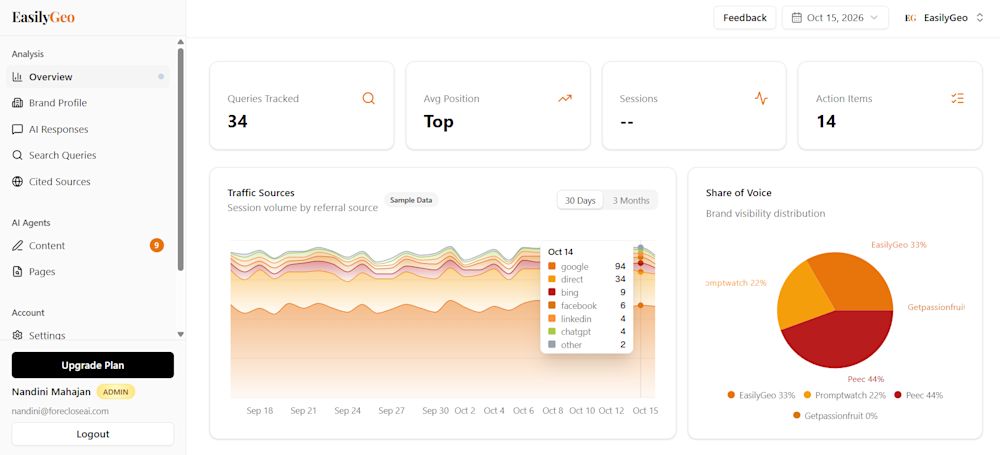
If you want to rank for a keyword in 2026, do not stop at checking Google positions. Use EasilyGeo to see how your brand shows up across ChatGPT, Perplexity, Gemini, Claude and more, which sources those engines cite, what prompts trigger your brand and where competitors are outranking you.