Brand Sentiment in AI Search: Measure and Improve It
On this page
Key Points
- Brand sentiment now includes what AI platforms say about your company, not only what customers post on review and social platforms.
- AI search can compress information from multiple sources and repeat the same claims throughout the buyer journey.
- The EasilyGeo dashboard brings Brand Sentiment, Position Trends, Brand Citations and Brand Search Queries into one view.
- Brand Search Queries show the keyword, keyword volume, competition level and search intent, helping teams prioritize the opportunities that matter most.
- Improving negative AI sentiment starts with finding the prompts and cited sources shaping the answer, correcting factual gaps and addressing genuine customer friction.
In PwC's 2024 U.S. trust survey, 90% of business executives said customers highly trust their companies. Only 30% of consumers said the same. That 60-point gap is the part most teams miss. Brand sentiment is not whatever a company hopes people feel. It is the version of the brand that appears in public language when someone else is doing the talking.
Purchase behavior can move quickly when sentiment changes. Qualtrics XM Institute findings show that 53% of consumers cut spending after a bad experience. The same research found that only a third of consumers give direct feedback every time something goes wrong. Much of the damage therefore appears in reviews, forums, social posts and private conversations before the brand team sees it.
AI-led discovery is now part of that loop. In Adobe's March 2025 consumer survey, 39% of U.S. consumers said they had used generative AI for online shopping, and 55% of those users said they used it for research. Adobe also found that visitors arriving from generative AI sources showed higher engagement and lower bounce rates than other traffic sources.
The search layer changed with unusual speed. In May 2025, Google said in its AI Mode update that AI Overviews was driving more than a 10% increase in usage for the kinds of queries that trigger it in markets such as the United States and India. Google also explained that AI Mode can break a question into subtopics and run multiple searches on a user's behalf before synthesizing the answer.
OpenAI's ChatGPT search announcement noted that ChatGPT search became available to everyone on Feb 5, 2025. Buyers now use ChatGPT, Perplexity, Gemini, Claude and Google AI experiences for brand checks, product comparisons and reputation research before they ever reach a company's homepage.
That is why brand sentiment now includes more than reviews and mentions. It also includes what AI systems say about your brand, which sources they cite, where your brand appears, which searches trigger the mention and whether that visibility is improving or slipping over time.
Brand sentiment is the pattern behind what people and AI say about your company
Brand sentiment is the pattern inside the language around your company. Positive sentiment sounds like “easy onboarding,” “worth the price” or “support solved it fast.” Negative sentiment sounds like “hidden fees,” “slow response times” or “not reliable for larger teams.” Neutral sentiment is descriptive without much emotion, such as a directory listing or a dry product summary.
Mixed sentiment is the common real-world version: a Reddit thread may praise a product's capabilities but criticize its setup process, while an AI summary may call the brand a strong option for mid-market buyers but expensive for smaller teams.
Brand sentiment is different from awareness, share of voice, rankings and reputation:
Awareness asks whether people know the brand exists.
Share of voice asks how often the brand is mentioned compared with competitors.
Rankings or positions show where the brand appears in a result or generated answer.
Reputation is the broader, long-term impression created by customer experience, coverage and market behavior.
Brand sentiment measures whether the language surrounding the brand is positive, negative, neutral or mixed.
AI adds another layer. A model can describe your brand negatively or neutrally even when general web mentions look balanced because it repeatedly retrieves the same old complaint thread, thin comparison page or outdated review roundup.
A simple way to remember the problem is to ask: Who is making the claim? Where does it appear? How often does AI repeat it? Which source supports it? Is the brand's position improving or declining?
Why brand sentiment tracking changed with AI search
The old discovery path was mostly a list of links. A buyer searched, scanned the headlines and chose where to click. The new path is often compressed into a synthesized answer. Someone asks for alternatives, pricing expectations, implementation speed or a quick summary of what customers think, and the AI platform performs the first round of research.
Two things make this different. First, source compression means the model may retrieve information broadly while showing the user only a small collection of claims. Second, citation effects allow the same sources to reinforce the same story. If an old complaint thread, a stale comparison page and one review site keep getting surfaced, the answer can sound settled even when the wider web has moved on.
Sentiment in AI is therefore not just tone. It also appears in omission, source selection, placement inside the answer and whether a competitor is presented as the safer choice. Sometimes the damaging signal is not “this brand is bad.” It is that the brand barely appears while a competitor is mentioned first, supported by stronger citations and described in more confident language.
Modern monitoring must answer practical questions: Which searches trigger our brand? Where do we appear? Are the mentions positive, negative or neutral? Which sources influence the answer? Are we moving up or down across AI platforms? Which high-intent opportunities deserve attention first?
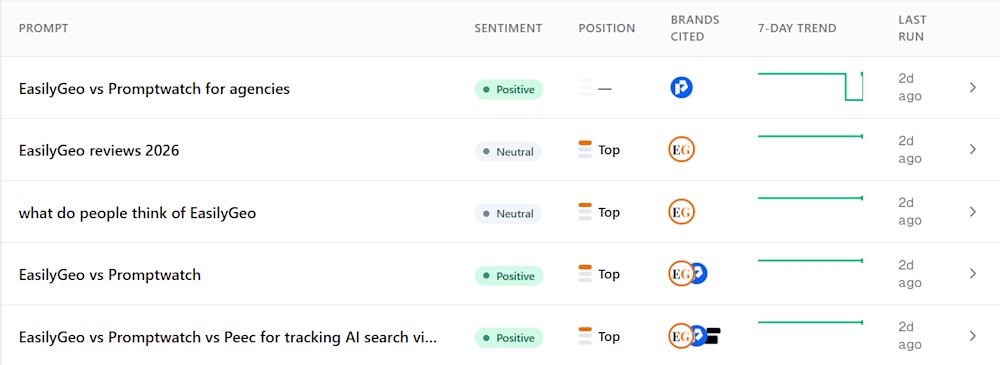
How the EasilyGeo dashboard turns AI brand sentiment into action
The EasilyGeo dashboard connects the main signals needed to answer those questions. Instead of treating sentiment, visibility, citations and keyword research as separate reports, teams can review them as parts of the same buyer journey.
1. Brand Sentiment shows how AI platforms describe your brand
The Brand Sentiment feature helps teams see whether AI-generated mentions are positive, negative or neutral. This gives marketers more than a raw mention count. It shows the direction of the narrative around the brand and makes it easier to identify recurring strengths, concerns or mixed messages.
For example, a company may be mentioned frequently but described as difficult to implement. Another may have fewer mentions but consistently receive positive language around reliability and customer support. Mention volume alone would miss that difference; Brand Sentiment makes it visible.
Teams can use this view to:
Spot repeated positive and negative themes;
Identify searches that produce unfavorable or uncertain descriptions;
Compare how the brand is framed across AI platforms; and
Decide whether the response requires better content, clearer evidence or a real product or service improvement.
2. Position Trends show whether visibility is rising or falling
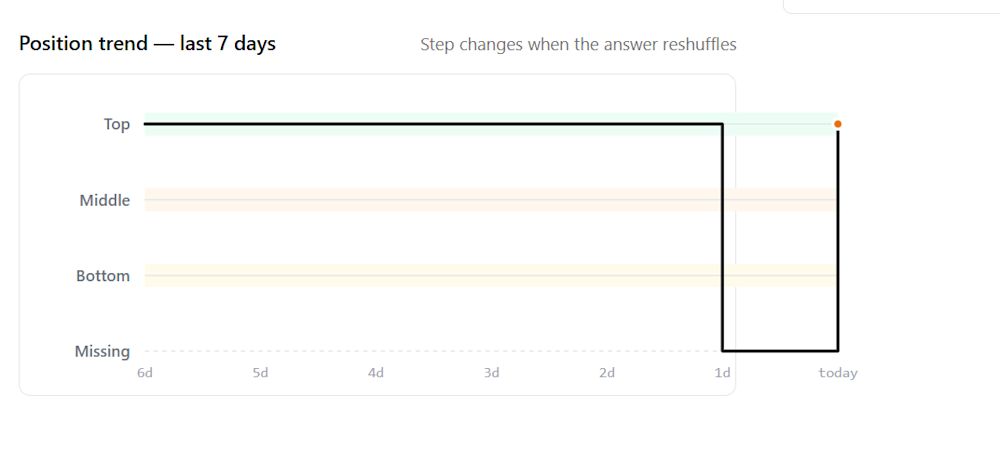
A single AI answer is only a snapshot. Position Trends add the time dimension by showing how the brand's placement changes across tracked searches.
This matters because a brand can continue to appear while gradually losing prominence. Moving from the first recommendation to a later mention may signal that competitors are providing stronger evidence, earning more citations or answering the search more directly. In the other direction, improving positions can show that recent content and authority work is beginning to influence AI visibility.
Position Trends help teams distinguish a temporary change from a consistent pattern. They can see where visibility is stable, where it is improving and where it is slipping before the decline becomes a larger acquisition or trust problem.
3. Brand Citations reveal which sources support the AI answer
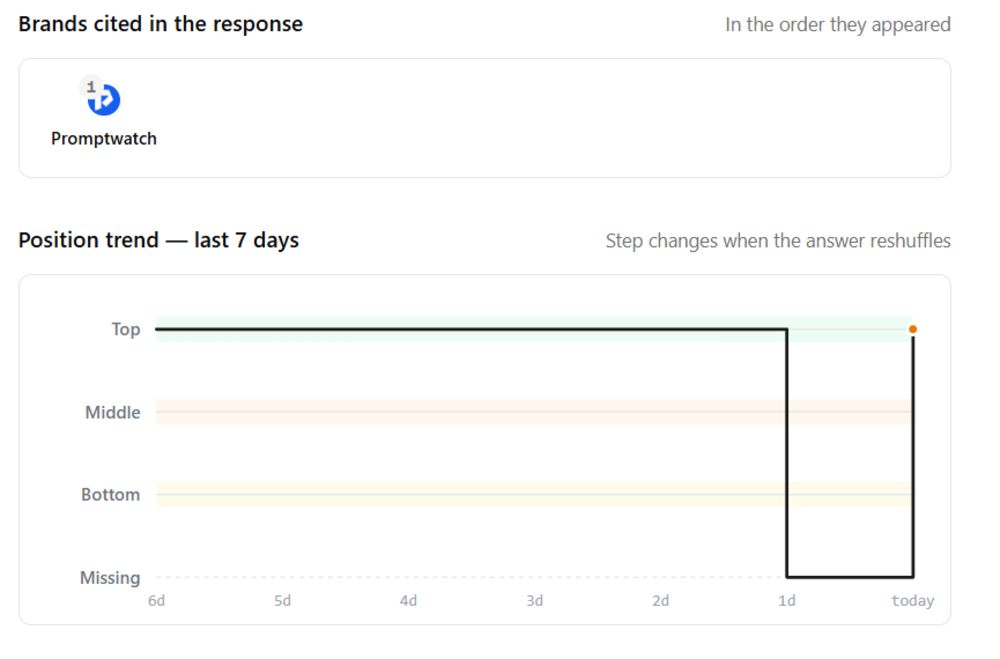
Brand Citations show the sources AI platforms use when discussing a company. This is essential because the source often explains the sentiment.
If an AI answer is negative, the citation view can point the team toward the review, forum discussion, comparison article or outdated page influencing it. If the answer is accurate and positive, Brand Citations can reveal which assets are successfully building trust. The same view also shows when AI platforms cite competitors or third-party sites instead of the brand's own current information.
Teams can use Brand Citations to:
Trace an AI claim back to its supporting source;
Find outdated or inaccurate information;
Identify third-party pages with strong influence;
See whether owned content is being used as evidence; and
Discover the types of content AI platforms trust for a topic.
The goal is not simply to collect more citations. It is to earn citations from accurate, relevant and trustworthy sources that help AI systems describe the brand correctly.
4. Brand Search Queries show the searches behind brand visibility
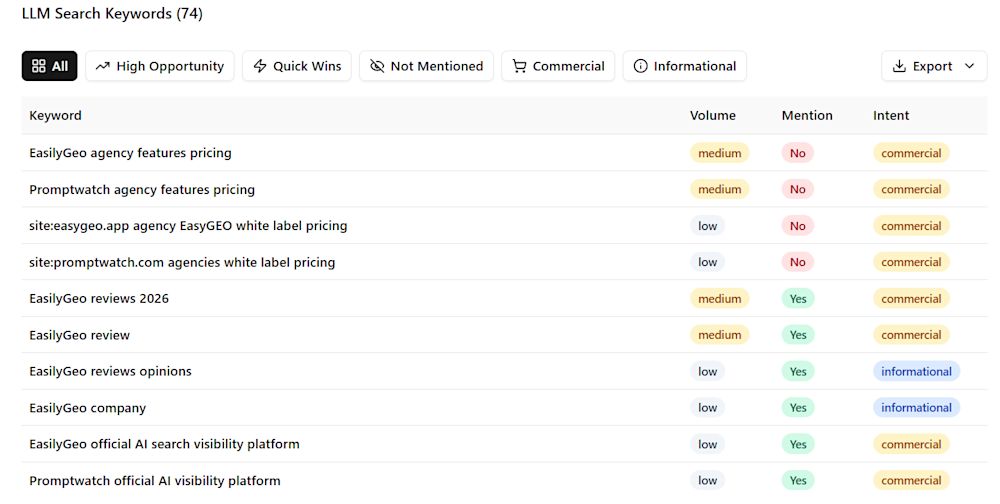
Brand Search Queries reveal the keywords and question themes for which the brand appears. Each query includes useful decision-making fields such as:
Keyword: the term or search topic associated with the brand mention;
Keyword volume: an estimate of how often people search for that topic;
Competition or difficulty: a displayed level such as Medium, helping the team judge how competitive the opportunity may be; and
Intent: the reason behind the search, such as informational, commercial or transactional intent.
These details prevent teams from treating every mention as equally important. A low-volume informational search may be useful for education, while a high-volume commercial comparison can have a more direct effect on pipeline. Intent also helps the team choose the right response. An informational query may need an expert guide, while a commercial query may need a comparison page, use-case page, customer proof or clearer pricing information.
Together, these four dashboard areas create a connected workflow:
Brand Search Queries identify where the brand appears → Brand Sentiment shows how it is described → Brand Citations explain why the answer looks that way → Position Trends show whether the response is improving over time.
What good brand sentiment tracking looks like
A strong setup traces sentiment back to its inputs instead of summarizing everything in one score.
Track review platforms for star ratings, text patterns and recurring product or service themes.
Track social mentions, Reddit, niche forums and creator communities where blunt language often appears early.
Track news coverage, analyst sites and comparison pages because they can shape trust before a buyer contacts sales.
Track support tickets, call transcripts and chat logs because unresolved owned-channel friction often becomes negative public language later.
Track pricing pages, policies, FAQs, use-case pages and help-center content because weak or outdated information leaves room for others to define the brand.
Track AI answer snapshots across relevant platforms, then connect sentiment with citations, positions, search queries and competitor overlap.
The review cadence can remain simple. Weekly checks catch movement. Monthly reviews show patterns. Event-based monitoring matters after product launches, outages, pricing changes, major reviews or PR issues.
What tools measure brand sentiment, and where does each one fall short?
Each tool category sees a different part of the problem.
Tool category | What it captures well | Where it falls short |
Traditional social listening tools | Conversation volume, themes and spikes in public chatter | Often weak on owned-site context and AI-generated answer visibility |
Review and survey platforms | Direct customer feedback, ratings, NPS-style trends and experience themes | Miss wider web narratives, forum discussions and AI summaries |
Web monitoring and media intelligence tools | Press coverage, publisher mentions and formal media narratives | May miss prompt-level AI behavior, niche communities and query intent |
AI visibility and brand sentiment platforms | How AI describes a brand, where it appears, which sources are cited and how visibility changes | Still require teams to correct content, improve operations and address customer friction |
EasilyGeo | Connects Brand Sentiment, Position Trends, Brand Citations and Brand Search Queries, including keyword volume, competition level and intent | The data identifies what to prioritize; the organization must still execute the content, product, support or PR response |
The strongest approach is not to replace customer research or social listening. It is to connect those inputs with what AI platforms are now presenting during discovery.
How to improve negative brand sentiment in AI
Negative AI sentiment is usually a source and evidence problem before it is a model problem. Start by identifying the exact searches that produce the negative description. Save the answer, record the repeated claims and inspect the cited sources.
Then separate factual errors from legitimate criticism. An outdated pricing claim requires a correction and clearer current information. A recurring onboarding complaint may require a product, support or implementation change. Publishing a new article will not fix a real customer experience problem by itself.
Prioritize issues using the dashboard signals:
Use Brand Search Queries to find the relevant keyword, its volume, competition level and intent.
Use Brand Sentiment to identify searches with negative or mixed language.
Use Brand Citations to locate the sources shaping the answer.
Use Position Trends to see whether the problem is isolated or becoming more prominent.
Make the necessary content, product, support or communications change.
Continue tracking the query to see whether sentiment, citations and position improve.
The repair work is usually practical: update pricing and policy pages, expand FAQs, clarify setup or migration information, publish stronger customer evidence, respond to recurring review themes and correct outdated comparison content where possible. If owned pages are difficult for AI systems to retrieve or interpret, start with EasilyGeo's free AI visibility check.
Success should be measured by more than a change in tone. Did the brand's current pages begin appearing as citations? Did its position improve? Did a negative query start producing a more balanced answer? Did competitor dominance decline? The dashboard helps teams observe that movement instead of relying on two isolated screenshots.
How marketers can use the dashboard to decide what to create next
Imagine a SaaS marketer tracking the query “best payroll software for remote teams.” The brand still appears, but Brand Sentiment is neutral. Position Trends show that it has moved from an early recommendation to a later mention over several weeks. Brand Citations show that the answer relies on old review roundups instead of the company's current product pages.
The marketer opens Brand Search Queries and reviews the keyword, keyword volume, the competition level shown as Medium and the commercial intent. That combination signals a meaningful opportunity: the search has buyer value, the brand is already relevant enough to appear, but its evidence is not strong enough to lead the answer.
The team can now diagnose the content gap. Perhaps the model is uncertain about pricing transparency. Maybe implementation speed is missing, or the company has not published enough evidence about remote onboarding. The response can be specific: improve the comparison page, publish a sourceable FAQ, add customer proof or build a focused use-case page.
That is more useful than a generic instruction to “publish more content.” The dashboard turns a sentiment problem into a prioritized brief:
The query defines the topic;
Volume indicates potential demand;
Competition helps estimate the difficulty;
Intent determines the best content format;
Citations show which evidence must be improved;
Sentiment shows the narrative to correct or strengthen; and
Position trends show whether the work produces lasting improvement.
A simple scorecard helps teams spot sentiment problems early
A monthly scorecard can fit on one page. Track the overall mix of positive, negative and neutral AI mentions. Record the leading positive and negative themes. Review sentiment by platform, Brand Citations, Position Trends, competitor comparisons and the search queries with the largest visibility changes.
Ownership should be shared. Marketing can address messaging and content gaps. PR can handle high-risk external claims. Customer support can surface repeated complaint themes. Product can own fixes connected to real friction. SEO and content teams can map queries, strengthen sourceable pages and monitor progress.
The red flags are not always obvious. Review scores may remain stable while the brand loses visibility on high-intent searches. Social chatter may stay neutral while AI answers continue to cite old complaint threads. That is why ongoing tracking matters more than a one-time cleanup.
See what AI search is saying about your brand
Brand sentiment now lives in two places at once: public conversation and AI-generated answers. Watching only one means missing part of the story buyers may encounter first.
See how AI search talks about your brand with EasilyGeo. Use Brand Sentiment to understand whether AI presents your brand positively, negatively or neutrally. Follow Position Trends to see whether visibility is improving. Review Brand Citations to find the sources shaping the answer. Explore Brand Search Queries to see the keyword, keyword volume, competition level and intent behind each opportunity.
Together, these insights help your team catch declining visibility earlier, investigate the source of negative claims, prioritize high-value searches and create the evidence AI platforms need to describe your brand accurately.