How To Get More Clients: 10 Proven Strategies for 2026

On this page
- Why growing a therapy practice in 2026 depends on visibility, trust, and timely follow-up
- What prospective therapy clients look for before booking their first session
- Which client acquisition channels are best for solo therapists vs group practices
- How to measure what is actually bringing in new therapy clients
- Build Trust Consistently, and Clients Will Follow
Finding new therapy clients in 2026 is not just a marketing challenge; it is a visibility and trust challenge. The need is real. According to the National Institute of Mental Health, more than 1 in 5 U.S. adults were living with a mental illness in 2022. At the same time, the path people take before booking care is increasingly digital. Pew Research Center reports that 85% of Americans at least sometimes get health information from healthcare providers, but that search, online sources, and digital convenience all shape how people evaluate options before they ever make contact.
For therapists, this shift presents both an opportunity and a challenge. Visibility is no longer limited to ranking on the first page of search results. Your online presence now spans Google Business Profile, therapist directories, review platforms, educational content, social media, and even AI assistants that summarize information from across the web. Prospective clients often compare several therapists in just a few minutes, looking for clear expertise, trustworthy reviews, convenient booking options, and a profile that makes them feel understood.
Getting more therapy clients in 2026, therefore, isn't just about marketing more; it's about being visible where people are searching, building trust at every touchpoint, and making it easy for someone to take the next step when they're ready. The 10 proven strategies below will help you strengthen your online presence, improve client acquisition, and turn more prospective visitors into booked appointments.
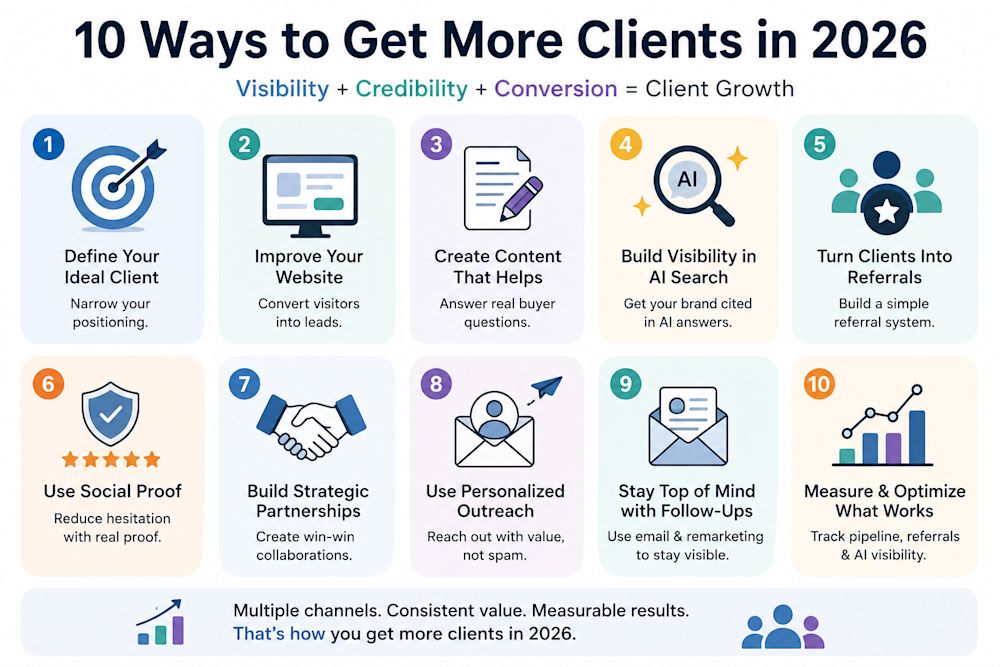
Why growing a therapy practice in 2026 depends on visibility, trust, and timely follow-up
People rarely choose a therapist based on credentials alone. They want reassurance that you understand what they're experiencing, offer the support they need, and are easy to contact when they're ready. For many, the decision to seek therapy happens during moments of stress, uncertainty, or emotional overwhelm. In those moments, clear communication, empathy, and a simple booking process can matter just as much as professional qualifications.
Today's client journey is also far more fragmented than it was a few years ago. A prospective client may discover your practice through Google Search, compare your profile on therapist directories, read a blog about anxiety or burnout, check your reviews, and even ask an AI assistant to recommend therapists nearby. The practices that consistently attract new clients are those that maintain a trustworthy, consistent presence across every stage of that journey.
What prospective therapy clients look for before booking their first session
Before contacting a therapist, most people are trying to answer a few practical but important questions. Do you specialize in the concern they're facing? Do you accept their insurance, or are your fees within their budget? Are you licensed to provide telehealth in their state? Do your appointment hours fit their schedule? Beyond these logistical factors, they're also looking for something less tangible: reassurance that they'll be understood. The tone of your website, profile, and content often shapes that first impression.
Visibility alone is no longer enough. While people may discover your practice through search engines, online directories, reviews, social media, or AI-generated recommendations, they only take the next step when your messaging builds confidence and reduces uncertainty. The most effective marketing strategies combine discoverability with trust, making it easy for prospective clients to feel understood and book their first appointment.
1. Clarify your niche so the right clients can recognize themselves
General messaging often underperforms because it asks the client to do the interpretation work. “I help people with life challenges” is broad, but it does not help someone know whether you are the right fit. More specific positioning, such as anxiety therapy for young professionals, trauma-informed couples therapy, postpartum mental health support, teen therapy, or LGBTQ+ affirming care, increases conversion because it helps the client feel seen.
This works because therapy is personal. People are not searching for a generic provider; they are searching for someone who understands their situation. Rewrite your homepage, therapist bio, and directory profiles around problems, populations, and outcomes. Instead of describing only your methods, explain who you help, what they may be experiencing, and what improvement can look like.
2. Build a website that converts visitors into consultation requests
A therapy website should reduce hesitation within seconds. Above the fold, visitors should see who you help, where you serve, and how to take the next step. A strong site also includes a therapist bio with credentials, specialty pages, clear fees and insurance information, HIPAA-safe contact options, FAQs about the process, and frictionless booking.
Empathy and clarity are the goal. Your copy should sound professional but human, not clinical for the sake of sounding impressive. Mobile optimization and fast load times are also trust signals. If your site is slow, confusing, or hard to navigate on a phone, you lose people before they ever read your qualifications.
3. Improve your local SEO so nearby clients can find you first
For many private practices, local discovery is still the primary acquisition channel. Your Google Business Profile should be fully optimized with accurate categories, business hours, office photos, service descriptions, and regular updates. Your name, address, and phone number should match across your website and listings. If you serve multiple areas, local landing pages can help capture neighborhood-based intent.
Directories still matter because they influence both search visibility and trust. Psychology Today, Healthgrades, TherapyDen, Zocdoc, and relevant local professional listings can all reinforce your presence. Enhancing those profiles with consistent bios, specialties, and telehealth details makes it easier for both search engines and prospective clients to understand your practice.
4. Earn and manage reviews to strengthen trust at the moment of choice
Reviews are especially powerful in therapy because they help reduce fear. A strong review profile signals professionalism, responsiveness, and a positive experience. But this is also a sensitive area. Review requests must respect privacy, avoid pressure, and follow platform and ethical guidelines. The best approach is to make requests appropriate and optional, often at a natural closing point in care. If reviews appear, respond professionally and briefly, without confirming anyone was a client. Reputation affects both visibility and conversion. Even when a person discovers you elsewhere, they often check reviews before deciding whether to contact you.
5. Create educational content that answers the questions clients ask before they reach out
Educational content helps prospective clients take the first step because it lowers uncertainty. A simple article on what to expect in the first therapy session, a short video on CBT vs. EMDR, or a guide to signs you may need therapy can all build confidence. Topics like online therapy, burnout, grief, anxiety, and relationship conflict align naturally with informational search intent.
Write in plain, compassionate language. People looking for help are not impressed by jargon. They want reassurance, accuracy, and next steps they can understand. Content can then be repurposed into social posts, email newsletters, and directory snippets. If your team wants to better understand how educational content gets surfaced in AI-driven discovery, the EasilyGeo blog has useful reading on AI visibility and search behavior.
6. Make your practice visible in AI-powered search and recommendation tools
Traditional search rankings still matter, but they are no longer the whole picture. AI Overviews, assistants, and answer engines increasingly summarize providers and cite outside sources. That means your discoverability depends not only on your website, but also on the consistency of your bios, directory listings, brand mentions, and trusted third-party citations.
Therapists and clinics should make sure their specialty descriptions are accurate, their profiles are consistent across the web, and their content is structured clearly enough for machines to interpret. For practices that want to see how they appear in AI-generated discovery across engines and locations, EasilyGeo can help monitor brand citations, source patterns, and competitor visibility in a more systematic way.
7. Use email and lead nurturing to convert people who are not ready yet
Many prospective clients are interested before they are ready. A missed moment does not always mean lost demand. A thoughtful follow-up sequence after an inquiry, a welcome email with what to expect, or a monthly mental wellness newsletter can keep your practice top of mind without being intrusive.
The key is consent and usefulness. Helpful lead magnets, such as coping resources or a first-session guide, can support people while they are deciding. This approach works particularly well for private-pay therapy, couples work, and telehealth services where the decision window may be longer.
8. Build referral relationships with doctors, schools, employers, and community partners
Referral networks remain one of the most durable ways to get more therapy clients. Primary care physicians, psychiatrists, OB-GYNs, HR teams, school counselors, clergy, doulas, and even attorneys can all become valuable partners depending on your niche.
Create a concise referral sheet that explains your specialties, ideal client profile, insurance status, service area, and contact process. Then follow up consistently. Referral marketing works because it transfers trust. When another professional understands exactly who you help and has confidence in your responsiveness, they are far more likely to send the right people your way.
9. Test paid ads carefully for high-intent services and locations
Paid ads can work well for some therapy practices, especially private-pay niches, telehealth across licensed states, or underserved local markets where demand is strong. They are less effective when the landing page is weak, the service is too broad, or tracking is unclear.
Start small and measure carefully. Use campaigns for specific services and geographies rather than generic brand awareness. In therapy, ad success depends heavily on message match, landing page trust, and disciplined budget control. Compliance and privacy considerations should always be reviewed before launching.
10. Respond faster and simplify booking because speed wins clients
Inquiry handling often determines who gets the client. If one therapist responds within an hour and another replies three days later, the faster practice usually wins. Clear voicemail instructions, online scheduling, short intake forms, and multiple contact options can dramatically improve conversion without increasing traffic.
Here is a practical order of operations for most practices:
Tighten your niche messaging.
Improve your website’s clarity and booking flow.
Optimize your Google Business Profile and directories.
Strengthen reviews and referral relationships.
Add content, nurturing, and AI visibility tracking as you scale.
Which client acquisition channels are best for solo therapists vs group practices
Solo therapists usually benefit most from focused positioning, local SEO, directory optimization, reviews, and referral partnerships. Those channels are relatively cost-efficient and often produce the fastest traction when capacity is limited. A solo practice rarely needs every growth tactic at once; it needs the right few done consistently.
Group practices have more leverage in scale. They can publish more content, invest in paid acquisition, manage multi-location local SEO, and compare performance by clinician, service line, or geography. They also benefit more from analytics tools that show how visibility changes across channels, including newer AI-driven environments. For teams exploring this trend, The Rise of GEO: How AI Search Is Replacing Google offers helpful context.
Practice model | Best early priorities |
|---|---|
Solo therapist | Niche messaging, website conversion, Google Business Profile, directories, reviews, referral partners |
Group practice | Multi-location SEO, content scaling, paid ads, channel attribution, AI visibility monitoring |
How to measure what is actually bringing in new therapy clients
The most useful metrics are not vanity metrics. Track traffic quality, consultation requests, booked sessions, source of lead, cost per lead, conversion rate by channel, and lifetime value where relevant. This tells you whether your marketing is producing the kind of clients you actually want.
It is also worth tracking emerging discovery patterns. If leads mention finding you through a directory, a review platform, a Google map result, or an AI assistant, capture that. As search evolves, practices that monitor both traditional and AI-driven visibility will make better decisions. If you are curious about how brands are being cited in AI systems, AI Trust Score (ATS): Which Domains ChatGPT Cites gives a useful view into source patterns.
Build Trust Consistently, and Clients Will Follow
Growing a therapy practice isn't about trying every marketing tactic at once; it's about consistently showing up where potential clients are looking and giving them confidence to reach out. A clear specialization, a trustworthy website, strong visibility on Google and therapist directories, authentic client reviews, and prompt follow-up create a foundation that attracts the right clients over time.
Instead of spreading your efforts too thin, focus on implementing two or three strategies well and measure their impact over the next few months. As your online presence becomes more consistent and your credibility grows, every channel, from search engines and referrals to social media and AI-powered search, starts working together. In a profession built on trust, the practices that invest in clarity, accessibility, and meaningful connections are the ones most likely to see sustainable client growth in 2026 and beyond.
Next step: Audit where clients can find and trust your practice
Take 30 minutes this week to evaluate how your practice appears online. Review your niche messaging, website experience, Google Business Profile, directory listings, client reviews, referral channels, and how your practice is represented in AI-powered search. Small improvements in visibility and credibility can make it much easier for the right clients to find and choose you.
If you want a deeper view of where your brand is being discovered, cited, and recommended across AI search platforms and different geographies, tools like EasilyGeo can help you uncover visibility gaps and identify opportunities to strengthen your online presence and support sustainable client growth.