The Hidden Problem With AI Citations
On this page
Imagine spending months researching a topic, collecting original data, publishing the findings, and finally seeing your work show up in an AI-generated answer. At first, it feels like a win. Your page has been discovered. Your research has been used. There is even a citation pointing back to your website.
Then you read the answer carefully.
Your brand isn't mentioned.
The statistic is there. The insight is there. Your work is there. But the reader has no idea who produced it unless they stop, notice the citation, and click through.
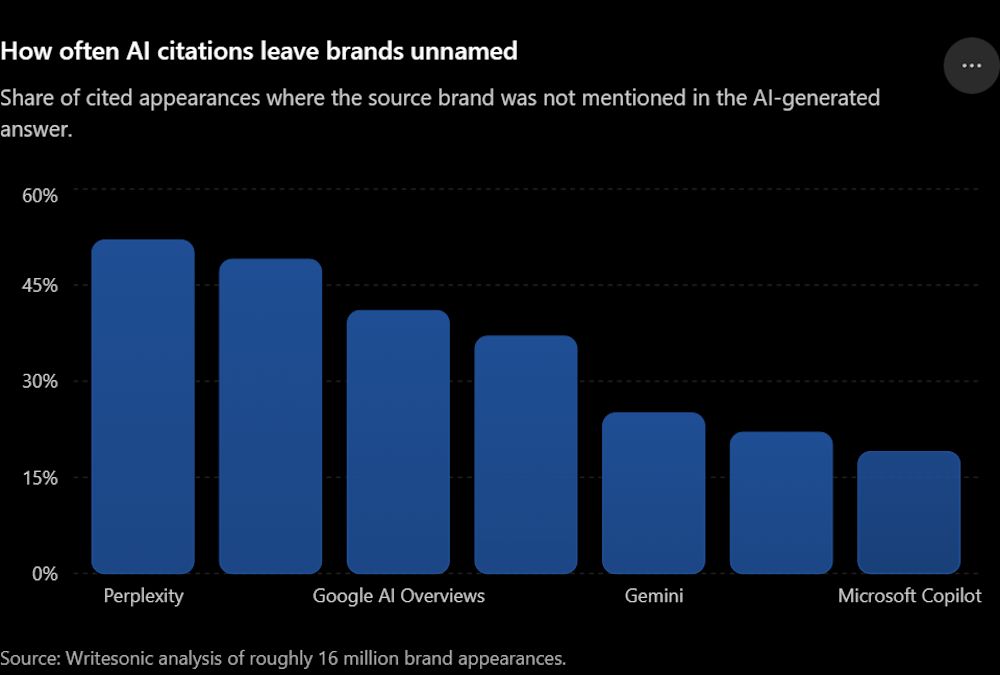
This is the strange visibility gap emerging in AI search: your content can get credited as a source without your brand getting credit in the conversation.
It has a name now: ghost citation.
A ghost citation happens when an AI engine links to a piece of content as a source but doesn't mention the brand behind that content in the answer itself. It sounds like a small distinction, but it changes what an AI citation actually means for a business. A citation tells you that the system found your content useful enough to support its response. A brand mention tells you that the person reading the response actually saw your name. Those two things used to feel like they were naturally connected. In AI search, they aren't always.
And the numbers suggest this isn't some rare edge case.
The problem may be even bigger than it first appears. A June 2026 Semrush study found that 61.7% of AI citations were “ghost citations” cases where an AI system linked to a brand’s content but never actually mentioned the brand in its answer. Only 13.2% of appearances resulted in both a citation and a brand mention, while 25.1% mentioned the brand without citing it. In other words, being cited by AI doesn't necessarily mean your audience sees your name.
Fake references are not the main problem. False authority is.
Most people know what an AI hallucination looks like when the paper simply does not exist. That is the easy case. The harder case is an answer that comes wrapped in the costume of evidence: a journal name, a DOI-shaped string, an institutional report title, and a tone that sounds settled. Readers lower their guard because the answer feels sourced. The citation trail looks professional even when the model is improvising from patterns rather than evidence.
This is also why AI makes up sources so convincingly. Large models are optimized to keep answering. OpenAI itself says standard training and evaluation often “reward guessing over acknowledging uncertainty.” Nature also reported in 2024 that bigger chatbots were often more likely to produce wrong answers than admit they did not know. So the biggest risk is not only fabricated citations. It is the answer that cites a real paper for the wrong claim, leans on a weak secondary source, or builds a false chain of authority from blog to summary to journal name. (openai.com)
Seven citation failure modes to know before trusting any AI answer
These are the patterns we keep seeing when we review AI-generated answers and when we watch citation behavior across engines and markets:
Nonexistent paper. The title fits the topic, the journal sounds right, and the paper cannot be found anywhere. This is the classic fabricated citation and still the cleanest failure to catch.
Real paper, wrong author list. The paper exists, but the model swaps in a better-known lab or drops authors. Smart readers miss this because the journal and topic still line up.
Real author, fake title. The author is real and works in the field, but the paper title is invented or merged from two papers. That makes a search feel almost successful.
Fake DOI. The string starts like a real DOI, but it resolves nowhere or points to a different article. Invalid identifiers are one of the most common ways fake precision sneaks in.
Dead-link URL. The source link 404s, points to a PDF mirror, or lands on a generic domain page instead of the cited article. Readers often assume the web moved and stop checking.
Source laundering through AI blogs or aggregators. The answer cites a polished blog post or roundup that itself cites another summary. By the time you reach the supposed origin, the underlying evidence is thin or missing.
Real citation, unsupported claim. This is the most dangerous one. The paper exists, the citation resolves, and the study still does not support the number, quote or conclusion the AI attached to it.
When AI cites the wrong source for the right brand
This is where citation quality becomes a visibility problem, not only a research-integrity problem. The question our customers ask most is not “Did the model mention us?” It is “Which source did it trust, in which market, and did that source actually support the claim?” We keep seeing answers that are directionally about a brand but sourced to scraped listicles, affiliate pages, stale comparison posts, or third-party summaries that flatten what the brand actually does.
That matters because AI discovery is increasingly source-led. A 2026 PMLR study on Google AI Overviews found that AI-generated documents were cited more often than human-authored ones even after controlling for retrieval rank. A recent Data & Policy paper also documented attribution gaps across search-enabled LLMs. This is exactly why we built our AI Trust Score and why AI visibility tracking across engines and geographies matters. Ordinary rank tracking will not show source laundering, citation volatility, or the competitor source advantage that becomes the model’s default authority.
Better citations need product fixes, editorial discipline and monitoring
What can be done is fairly clear. At the product level, models need tighter grounding, citation validation against real databases, better confidence calibration and cleaner abstention when the evidence is weak. At the workflow level, high-stakes use needs mandatory verification for claims, numbers and quotes. At the publisher and brand level, cleaner first-party pages, stronger documentation and more transparent provenance make it easier for both humans and models to find the right evidence. Journals and editors also need safeguards that catch fabricated or mismatched references before publication.
Model makers now make credible claims about reducing hallucinations. Good. The benchmark that would actually prove improvement is simpler than the marketing: fewer nonexistent citations, higher claim-support rates, lower misattribution across browsing modes, and better willingness to say “unknown” when the source base does not justify an answer. Until that is measured consistently, citation quality is still something to monitor, not assume.
Citation quality needs a dashboard, not a guess
See how AI engines cite your brand and sources across markets with EasilyGeo, so we can catch weak citations, unsupported claims, and competitor source advantages before they become the accepted answer.