AI Search Audit for Brand Mentions Across AI Engines
Key Points
- AI search now shapes buying decisions before users ever click a website.
- An AI search audit measures mentions, citations, accuracy and competitor presence across key platforms.
- Each AI platform needs its own scoring because retrieval, citations and controls work differently.
- Reliable audits use repeatable prompts, technical checks and content built for clear quoting.
- Run audits monthly to fix accuracy gaps, weak citations and lost share of voice.
Adobe reported in January 2025 that referrals from generative AI assistants to U.S. retail sites jumped 1,300% during the 2024 holiday season versus 2023, according to Adobe’s holiday season recap. That is a measurable change in shopping behavior: people are using AI to help decide what to buy before they click through to a retailer.
Bain put the zero-click side of the shift in even plainer terms in Bain’s zero-click analysis: about 80% of consumers rely on zero-click results for at least 40% of their searches. When an answer engine resolves the question inside the interface, your brand has to show up in the answer itself, not just in the links below it.
Gartner went a step further in Gartner’s 2024 forecast and said traditional search engine volume would fall 25% by 2026 as people moved to AI chatbots and virtual agents. Search demand is not disappearing. It is being redistributed across interfaces that summarize, cite and compare on the user’s behalf.
Google has kept widening that behavior. On Jan 27, 2026, the company updated the experience again in Google’s January 2026 update, adding Gemini 3 to AI Overviews and follow-up questions directly from the overview. That means more queries can be satisfied before a visit to any site.
OpenAI has moved the same direction inside ChatGPT. After making ChatGPT search broadly available in February 2025, it pushed further into shopping and discovery in March 2026 with OpenAI’s product discovery announcement. Perplexity also emphasizes real-time web answers with inline citations.
That is why an AI search audit matters now. If an AI answer mentions a competitor first, cites a weak third-party page or gets your pricing and positioning wrong, you can lose demand before the click exists. We built our AI visibility platform because teams kept asking us the same question: what do these systems actually say when buyers ask about us?
What an AI Search Audit Measures and How It Differs From a Classic SEO Audit
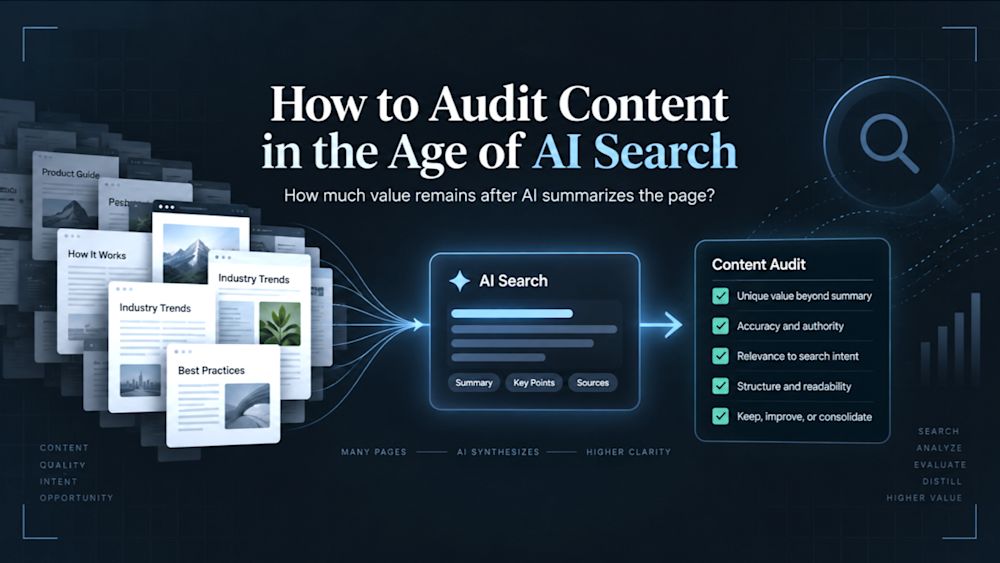
An AI search audit is a repeatable review of how AI systems retrieve, summarize, cite and rank your brand across the prompts that matter to buyers. We test branded prompts, category prompts, comparison prompts, problem-solution prompts and local intent prompts across ChatGPT, Google AI Overviews, Perplexity, Gemini, Claude and any other surface that shapes discovery in the category. (Google Search Central)
The simplest way to explain the difference between a GEO audit and an SEO audit is this: a traditional SEO audit asks whether a page can rank in a search engine; an AI visibility audit asks whether an LLM-powered surface can find that page, trust it, cite it accurately and mention your brand even when no click happens. If you want the broader framing, we unpacked it in the rise of GEO.
We score that work through four lenses: visibility, citation quality, answer accuracy and competitive presence. A GEO content audit for high-volume search queries belongs inside the same frame because the prompt set should cover the biggest informational and commercial questions in your market, not just vanity branded searches. (Bain and Company)
Why ChatGPT Google AI Overviews Perplexity Gemini and Claude Need Different Scores
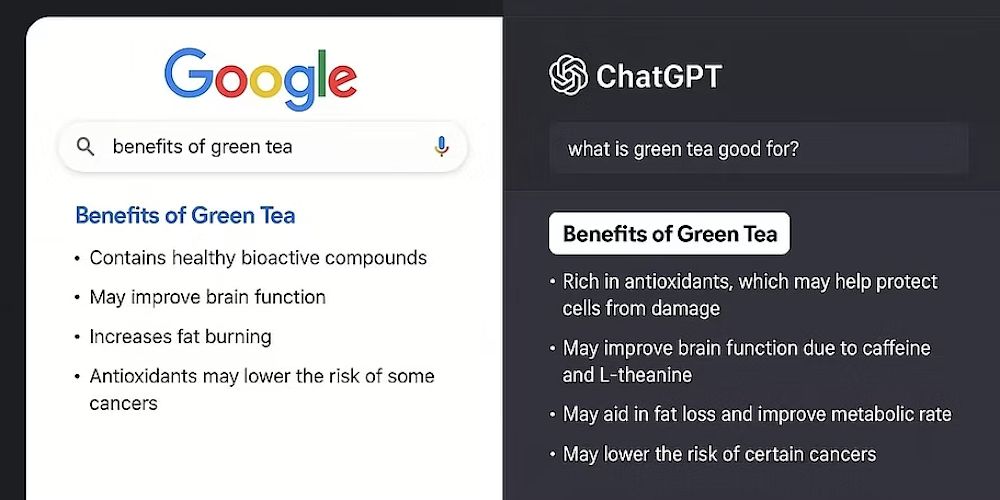
Each platform retrieves and presents information differently, so the same answer should not be scored the same way everywhere. Google AI Overviews sit inside Google Search and inherit Google’s indexing and snippet rules; ChatGPT Search mixes web retrieval with model synthesis; Perplexity shows citations prominently; Gemini can use Google Search grounding but varies by interface; Claude’s web behavior depends more on whether search features are active. (Google Search Central)
Platform | Highest-weight checks | Citation visibility | Freshness and local sensitivity | Controls |
Google AI Overviews | inclusion by query class | supporting links vary by trigger | very high on current, local and task-based queries | Googlebot plus nosnippet, data-nosnippet, max-snippet, noindex |
ChatGPT Search | mention rate and answer accuracy | source links appear in panels and summaries | high on current info and shopping | OAI-SearchBot access plus noindex for exclusion |
Perplexity | source share and page citation frequency | inline citations are central | high on research and comparison prompts | public controls are limited, so monitor observed source mix |
Gemini | interface-specific answer quality | grounded links vary by surface | high when Google Search grounding is used | usually shaped by Google indexing and preview rules |
Claude | web-enabled mention and citation behavior | citations appear when web search runs | medium to high depending on product context | audit by experience because integrations change behavior |
Those patterns come from each platform’s published docs and product pages, not from one blended visibility score. (Google Search Central)
Our weights change by platform. On Perplexity we care heavily about source share because the citations are explicit. On Google we put more weight on answer inclusion by query class and on snippet eligibility. On ChatGPT and Claude we watch answer accuracy hard because synthesis can compress multiple sources into one confident sentence. If Copilot matters in your category, fold it into the same matrix instead of forcing one blended score. (Google Search Central)
Build a Prompt Set You Can Actually Defend
Screenshots are useful for storytelling and terrible for measurement. A statistically defensible AI search audit treats testing like an evaluation exercise: fixed prompt definitions, repeat runs and documented settings. Recent ACL work on reproducible LLM evaluation makes the underlying point well: stochastic systems need repeatable protocols if you want results you can trust.
We segment prompts into branded, non-branded category, competitor comparison, problem-based, feature-specific, local and review or reputation queries. Then we fill the set from Search Console, paid search, site search, sales language and third-party keyword data. That is what we mean by GEO content audit for high-volume search queries. We note recurring patterns in our AI visibility blog but the seed list should come from your own demand data first.
Run each prompt more than once across different days and times because answer volatility is real. Control for logged-in versus logged-out state, location, browser history, device class and conversation memory. If you sell in San Francisco, Dallas and Miami, test all three. Local context can change who gets mentioned.
We want enough observations to separate drift from signal. For binary outcomes like mentioned or not mentioned, cited or not cited, Wilson confidence intervals work well. In practice that means dozens of prompts per segment and repeated observations per platform before you declare a gain or a loss. Competitor share of voice should be reported the same way. (arXiv)
Technical Readiness Still Decides Whether AI Can Reach You
AI systems cannot quote pages they cannot crawl, render or trust. Google says that pages shown as supporting links in AI Overviews or AI Mode must be indexed and eligible for Search snippets. OpenAI says sites that opt out of OAI-SearchBot will not be shown in ChatGPT search answers, although they may still appear as navigational links. Our free llms.txt generator helps with machine-readable discovery, but it does not replace crawlability or indexability.
Crawlability and robots: allow the right bots, remove accidental blocks and check WAF or CDN rules that return 403s to Googlebot or OAI-SearchBot. (Google Search Central)
Indexability and canonicals: clear noindex mistakes, broken canonicals, stale XML sitemaps, redirect loops and non-200 status codes before you worry about citations. (Google Search Central)
Rendering and speed: if critical copy only appears after heavy JavaScript or times out on mobile, retrieval systems may miss it or refresh it slowly. (Google Search Central)
Structure and metadata: keep titles, descriptions, H1s and schema consistent so the page can be identified and summarized cleanly. (Google Search Central)
Architecture and entity signals: connect product, pricing, docs, help and review pages with strong internal links plus clear Organization and Product data.
We usually start with documentation, pricing, product, help center and review pages because AI answers cite them constantly. Snippet controls matter too. Clear titles, concise descriptions and heading structure give retrieval systems better extraction points, while noindex or nosnippet should be used deliberately when a page is hurting you more than helping. (Google Search Central)
Content That Gets Quoted Reads Differently
The pages AI systems quote most often do not sound like brand theater. They define the thing, answer the obvious question early and back it up with specifics. We keep seeing lean documentation pages outperform polished homepage copy because the language is easier to parse. Our guide to writing for AI search goes deeper on that part.
On the page, audit for clarity, hierarchy and machine-readable structure. Answer-first intros, scannable subheads, short FAQ blocks, comparison tables, bylined expertise, dated updates and original data all help. So do plain statements of what the product is, who it is for, pricing context, limitations and proof. Ambiguous copy forces the model to guess. (Google Search Central)
Our AI Trust Score breakdown helps teams think about source quality, but the AI content audit metrics checklist itself should stay simple: citation rate, answer inclusion rate, sentiment and accuracy of brand mentions, source share, page citation frequency, prompt coverage and competitor outrank rate.
How to Run the Audit in EasilyGeo
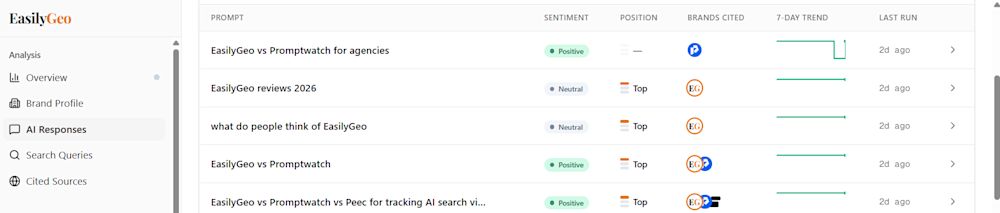
The EasilyGeo dashboard turns the audit from a collection of screenshots into a recurring workflow. Use Brand Profile as the reference point for expected naming, positioning and core claims. Build and refine the test set in Search Queries, then review the exact model output in AI Responses for inclusion, accuracy, sentiment and competitor framing.
Use Cited Sources and Top Cited Domains to see which owned and third-party pages are shaping the answer. The Overview page brings the operating metrics together, including Queries Tracked, Average Position, Sessions, Action Items, Traffic Sources and Share of Voice. That makes it easier to separate visibility gains from referral performance and to see where a competitor is gaining ground.
Once the audit identifies a gap, connect it to a specific fix. An incorrect answer becomes an accuracy action item. A missing citation becomes a source or page task. A weak comparison result becomes a content priority. The Content and Pages areas can then support the remediation workflow around the assets that need attention.
The Fastest Wins Come From Citations Accuracy and Share of Voice
Start by reading answers like a reviewer, not a fan. Does the response mention us at all? If it does, is the cited source ours or a reseller, directory, review site or forum? Is the description accurate? The question our customers ask most is why a model cites a third-party roundup before the page that actually explains the product. That is usually a source-trust or page-format problem, not a mystery. (OpenAI Help Center)
Then benchmark competitors prompt by prompt. In our GEO case studies, the quickest gains usually came from fixing missing comparison pages, stale docs and off-brand third-party citations. We score severity like this: critical for false claims or no mention on core buying prompts; high for competitor dominance on category prompts; medium for weak source mix; low for fringe edge cases.
A monthly AI search audit checklist keeps the team honest: top prompt coverage, citation source quality, answer correctness, competitor frequency and remediation status. We also keep a short queue of practical GEO tactics tied to each issue so the audit turns into shipping work, not another slide deck.
Make the Audit a Monthly Operating System
One-off audits decay fast because models, prompts and source ecosystems keep moving. The better setup is operational: SEO owns crawl and indexing fixes; content owns source pages; PR and comms own high-authority third-party mentions; product marketing owns message accuracy; support owns docs gaps; analytics owns the dashboard. Critical accuracy issues deserve 48-hour SLAs. High-priority source gaps get two weeks. (Google)
The monthly deliverable is simple: a platform scorecard, a prioritized issue queue, named owners and due dates. The dashboard should join AI visibility data with Search Console, web analytics, server logs, review platforms and share-of-voice tracking. We also like alerts for sudden drops in answer inclusion, new third-party citations outranking us and pricing or product claims that drift from reality. (OpenAI Help Center)
If you want that system without building it by hand, run an AI search audit with EasilyGeo to see how ChatGPT, Perplexity, Gemini, Claude and other AI engines talk about your brand, which sources they cite, what queries they use and where competitors are beating you.